
Today, we welcome Karina Nagin as a guest author. Thank you Karina for sharing your insights with us.
Your voice is part of who you are. It’s the way you say your child’s name, the sound of your laugh, the way you tease a loved one. For people living with ALS, losing the ability to speak is one of the hardest parts of the disease. Preserving a voice, and all the emotional connections it carries, has come a long way.
A Journey Nearly 50 Years in the Making
In the 1980s, DECtalk gave people who had lost their voice a way to communicate through technology. It required no recording, but it also had no personalization. There was just one generic, robotic voice available. Stephen Hawking used that voice for more than 30 years, and for a long time, it was the gold standard.
By the early 2000s, synthetic text-to-speech voices became more widely available, and people could choose from a small set of canned options. It was better, but still wasn’t “them”.
Then came personal voice banking. Tools like ModelTalker offered something remarkable — the chance to preserve your own voice — but the process was grueling. People living with ALS had to record over 1,600 phrases, often in soundproof booths, over weeks or months, all while managing fatigue and the emotional weight of a terminal diagnosis. And even after all that effort, the resulting voice still sounded stilted and robotic.
Over the next decade, the process got shorter thanks to early AI tools, and more people gained access to a voice that sounded recognizably like them. But something was still missing: emotion, intonation, the human quality that makes a voice truly sound like someone.
2024: A Fundamental Shift
For decades, voice preservation had one major catch: you had to start the process before your voice changed or weakened, or it wasn’t a possibility. ElevenLabs changed that.
AI voice cloning can create a natural-sounding voice from just seconds or minutes of existing audio, like an old voicemail, a home video, or a birthday message. No recording booth, no 1,600 phrases. And because it works from audio you already have, it can even reconstruct a voice that has already changed, or one that’s already gone. For the first time, a late diagnosis is no longer a disqualification from preserving your voice.
That same year, Bridging Voice became the first nonprofit impact partner of ElevenLabs, bringing this technology directly to people with ALS completely free of charge. In 2025, the technology went even further — preserving not just how someone sounds, but their full emotional range, so a voice doesn’t just sound like them, it truly feels like them.
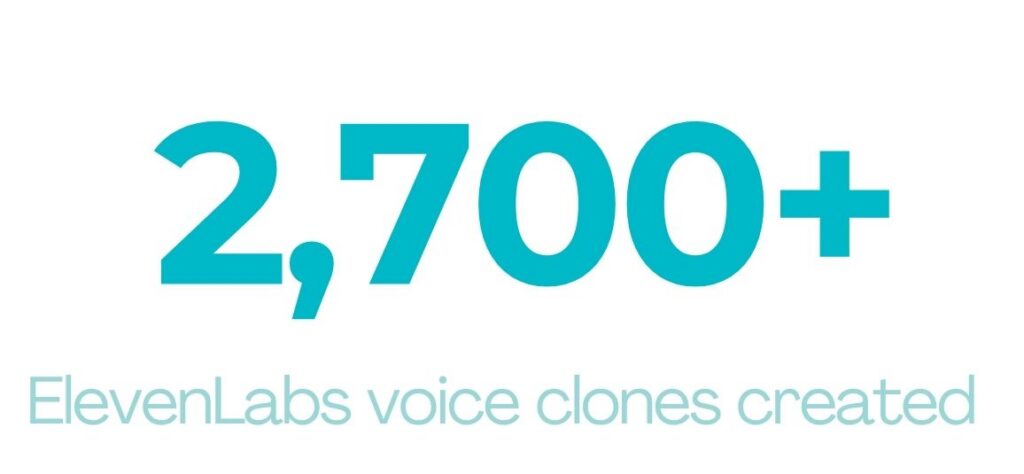
Since 2024, Bridging Voice has helped more than 2,700 people living with ALS access their AI voice clone. This has been life-changing for our clients. We’ve watched a mom be able to read her children bedtime stories in her own voice again, a father give a speech at his son’s wedding, and countless others simply say “I love you” in a voice their family thought they’d never hear the same way again.
How to Get Your Free Voice Clone
Through our partnership with ElevenLabs, Bridging Voice offers free AI voice clone licenses to people living with ALS. With this license, you can create a hyper-realistic clone of your voice and integrate it into any eye tracker or communication device.
You don’t need to be a Bridging Voice client to apply. Anyone living with ALS can request a free license.
Ready to get started?
Visit our ElevenLabs Impact Program page for full details on the program, the application process, and FAQs: https://bridgingvoice.org/elevenlabs
Read our AI Voice Cloning Overview for more background and support resources: https://bridgingvoice.org/links/ai-voice-cloning/
Have Questions? Join Us at Office Hours
Navigating ALS and communication technology can feel overwhelming, and you don’t have to figure it out alone. Every Tuesday at 4:30pm ET, Bridging Voice hosts Weekly Open Office Hours — a free, welcoming space where people living with ALS, family members, and practitioners can ask questions, connect with our team, and learn from one another.
Come with specific questions, or just join to listen and learn. Everyone is welcome. Register at: https://bridgingvoice.org/office-hours
Bridging Voice provides people living with ALS with free, remote technical support, training, and education for all their communication technology needs. Learn more at www.bridgingvoice.org.

Karina Nagin serves as Executive Director of Bridging Voice, where she focuses on organizational strategy, program development, and partnerships to ensure the organization’s mission is carried out with integrity, effectiveness, and long-term impact. She has over 20 years of experience in social impact leadership, with a career spanning global health, humanitarian response, education, and cross-sector collaboration.

Leave a Reply