
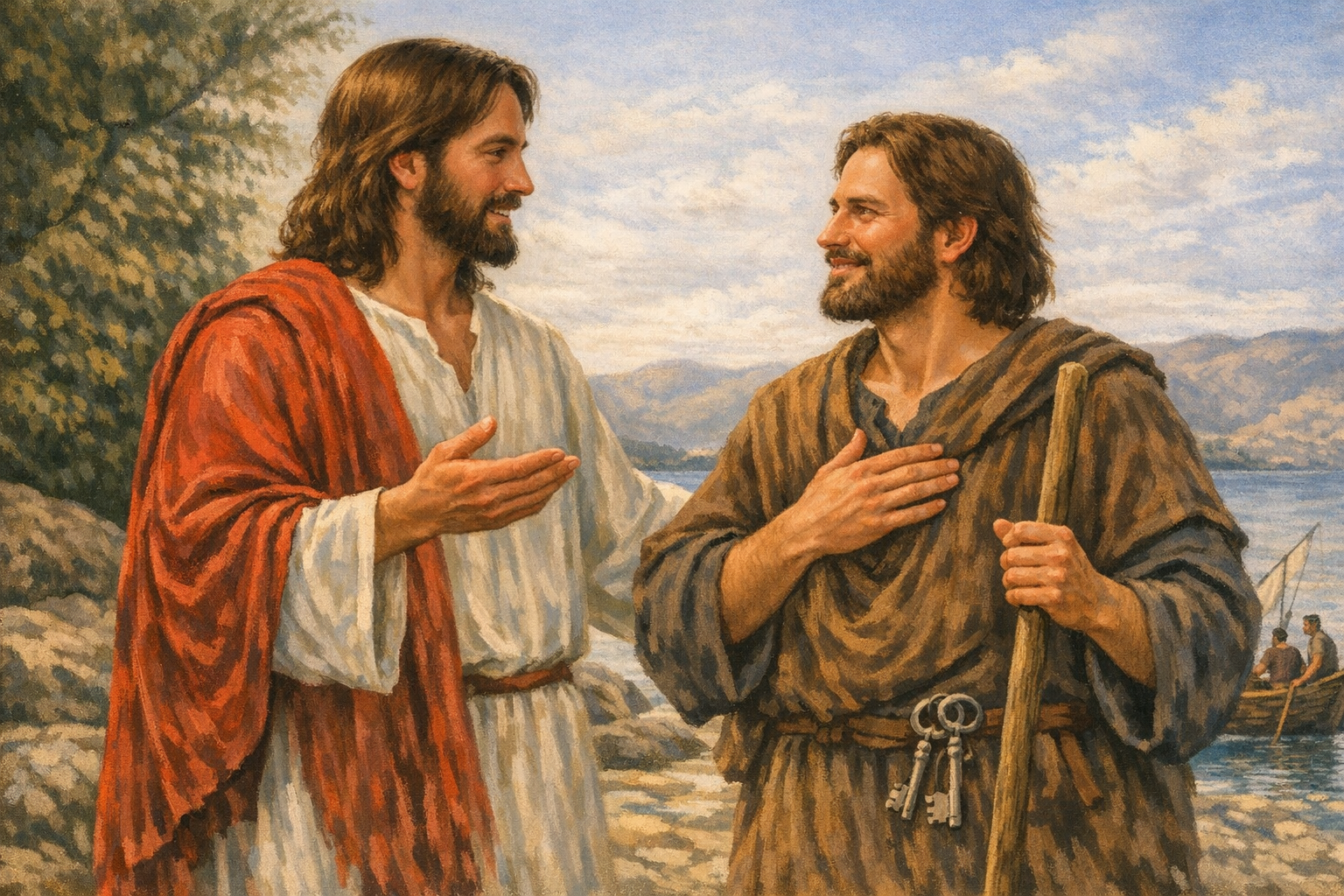
Week 12: Messiah
- Key verses: Psalm 110:1; Matthew 16:15-17
- Peter’s response
- Friends and family responses
- My response
- Parting thoughts
Key verses
Psalm 110:1 (NLT)
The Lord said to my Lord, “Sit in the place of honor at my right hand until I humble your enemies, making them a footstool under your feet.”
Matthew 16:15-17 (NLT)
Then he asked them, “But who do you say I am?”
Simon Peter answered, “You are the Messiah, the Son of the living God.”
Jesus replied, “You are blessed, Simon son of John, because my Father in heaven has revealed this to you. You did not learn this from any human being.”
Peter’s response
The disciples were asked the question and Peter answered. “You are the Messiah. The Son of the Living God.” Jesus is the promised one. And he is God. Later Jesus asked if they would leave him. They responded by asking where would they go? They found who they were looking for.
Family & Friends’ responses
I reached out to some family and friends for their responses to the question. Here are many of the responses.
Andrew H
My response to Jesus asking who do you say that I am is: Jesus is the Son of God, our savior and redeemer!
Kristyna F
The intercessor and perfecter of our faith
Kyle F
The Messiah, the King who was promised for our world and our hearts.
Danny W
Like Peter, after what I have heard, what I have learned and by what I have experienced. I must reply as Peter:
Matthew 16:13-16 NIV
[13] When Jesus came to the region of Caesarea Philippi, he asked his disciples, “Who do people say the Son of Man is?” [14] They replied, “Some say John the Baptist; others say Elijah; and still others, Jeremiah or one of the prophets.” [15] “But what about you?” he asked. “Who do you say I am?” [16] Simon Peter answered, “You are the Messiah, the Son of the living God.”
When Jesus disciples began leaving him because of their disappointment in him because he didn’t fit their description of a warrior king.
John 6:67-69 NIV
[67] “You do not want to leave too, do you?” Jesus asked the Twelve. [68] Simon Peter answered him, “Lord, to whom shall we go? You have the words of eternal life. [69] We have come to believe and to know that you are the Holy One of God.”
Adam J
You’re the person I’ve staked my entire life on without having met you face to face.
I don’t say that casually. I evaluate risk for a living. I pressure-test assumptions, walk away from things that don’t hold up under scrutiny. Five companies built and sold. The pattern is the same every time: show me the evidence, show me the math, show me what breaks when I’m wrong. I bring that same wiring to this question.
So, when someone asks who Jesus is, I can’t give the Sunday school answer and move on. “Lord and Savior” is technically correct, but it slides past people because they’ve heard it ten thousand times and it costs the speaker nothing to say it. Peter gave a better answer in Matthew 16. Jesus asked him point-blank: “Who do you say that I am?” Peter said, “You are the Christ, the Son of the living God.” Peter put his reputation, his safety, and his future on a single claim he couldn’t take back. Jesus told him flesh and blood didn’t reveal that. Something else was at work.
I resonate with Peter. But I resonate more with Thomas.
Thomas gets a bad reputation he doesn’t deserve. He wanted costly faith. Evidence before commitment. And here’s what gets me: Jesus showed up. Said, “Put your finger here” (John 20:27). Then he said something that’s haunted me for years: “Blessed are those who have not seen and yet have believed.” That’s me, and it’s every believer since the first century. Jesus acknowledged the weight of what he was asking of us.
And it is heavy.
Paul laid it out in 1 Corinthians 15 with zero ambiguity: if Christ hasn’t been raised, your faith is useless and you’re still stuck in your sins. He didn’t soften that. He didn’t offer a therapeutic fallback where Christianity is “still valuable as a moral framework” even if the resurrection didn’t happen. Paul said if it didn’t happen, we’re the most pitiful people alive. I respect that, actually. It means the whole thing is falsifiable. It stands or falls on a single historical event.
So I looked at it. The historical record for the resurrection. The behavior of the disciples afterward; people don’t get tortured and killed for something they know is a hoax. The internal coherence of what Jesus taught across four accounts written by different men. The manuscript evidence. The fact that Christianity exploded in Jerusalem; the one city on earth where disproving the resurrection would’ve been easiest if there was a body to produce. I weighed it the way I’d weigh any high-stakes decision. And I concluded he’s telling the truth about who he is.
But the intellectual case only got me to the door.
What happened when I walked through it is harder to explain and harder to dismiss. Deep structural change in my life when I stopped performing for God and started surrendering to him. The kind you can’t manufacture with discipline alone, and I’m a disciplined person. Something shifted that I didn’t produce. Anger I’d carried for years just… left. A compulsion to control outcomes that had driven every business decision I’d ever made loosened its grip. Relationships I’d managed like transactions became something I didn’t have a playbook for. Paul calls it “new creation” in 2 Corinthians 5:17. The old has gone, the new has come. I used to think that was poetry. Now I think it’s closer to a clinical observation.
Jesus is either God wrapped in human skin, or he’s the most dangerous liar in history. He claimed to forgive sins; that’s a claim only God gets to make. He claimed authority over death. Then he walked out of his own grave. C.S. Lewis made this argument in Mere Christianity, and nobody’s improved on it since: you don’t get to park Jesus on the “good teacher” shelf. He didn’t leave that option available. A good teacher doesn’t claim to be the Son of God unless he is one.
So, who do I say that he is?
He’s the one I’ve bet everything on. It’s the most pressure-tested decision I’ve ever made. Which, for a guy who evaluates risk for a living, is saying something.
My response
This is a haunting but critical question. If you dwell on it, you’ll begin to search your soul as you form your answer. As a Christian by tradition, it is easy for me to be flippant with my response and regurgitate the right answer whether I mean it or not. I have meditated on the question. My response was not instantaneous like Peter’s declaration, but it is similar. I am thankful for the time to focus on it. I encourage you to meditate on your response and then live in the truth of it.
Who do I say Jesus is?
Jesus, you’re my Savior and my Lord! Without you, I would have no hope. You are my brother by adoption and my friend by choice. I am looking forward to meeting you in person.
Parting thoughts
Who do you say Jesus is? He offers you the opportunity to follow him, to know him. When you answer, where does your answer come from? Are you saying well-rehearsed words, or speaking from your heart? Speak up and drop your response in the comments below.
Want to learn more?
Here’s some good reading from skeptics and scholars.
Want to know more? Use the contact form to reach out to me directly. I would love to help.
